
The Landscape as Witness
News of the WorldThis thread follows the Texas landscape as more than scenery: a force that shapes danger, memory, movement, and the travelers’ changing sense of the world.
increasing Bearing strength in each event
 decreasing
Bearing strength in each eventdecreasingThe Flooded Red
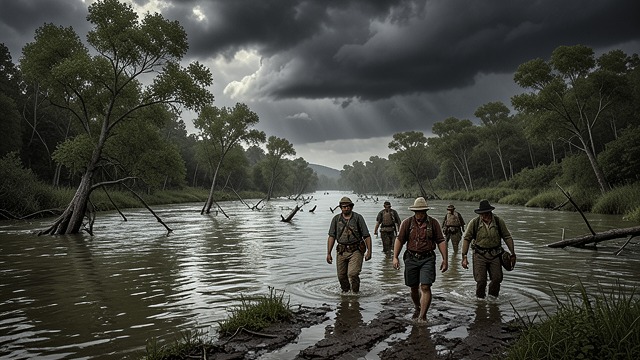
The Flooded Red
Water dictates the route
Rising water turns the Red River valley into a landscape of mud, drifting trees, and difficult crossings. Kidd must time and choose each passage rather than trust the road.
A boundary in motion
The river marks the edge of Indian Territory while also spilling beyond its banks. Its unstable force mirrors the travelers’ inability to rely on fixed political or personal boundaries.
The Brazos Ravine
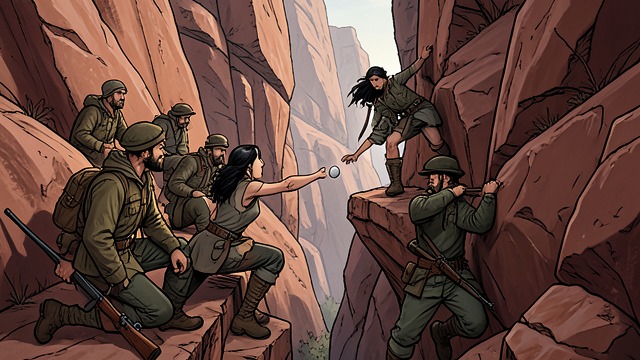
The Brazos Ravine
Terrain becomes defense
The red sandstone and concealed slopes at Carlyle Springs shape the fight. Kidd uses rock ledges as cover, while Cicada turns a slab of stone against an attacker.
The land changes the balance
The ravine initially gives the pursuers positions above the travelers, then becomes a source of improvised defense. The landscape participates in the struggle without becoming a simple backdrop.
The Burned Cabin
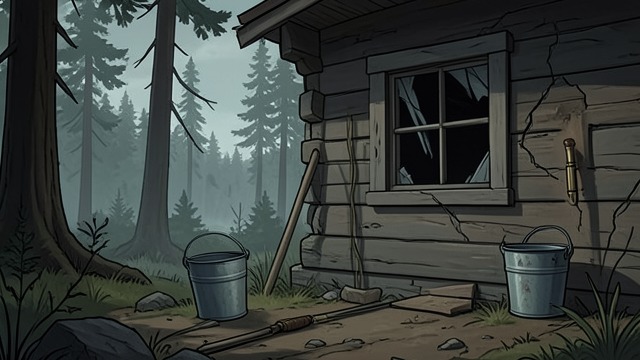
The Burned Cabin
A home reduced to traces
Kidd finds a ruined cabin containing household fragments and a bullet embedded in the wall. The damage suggests a family’s sudden absence without telling the full story.
Landscape as memory
The old path, water bucket, and animal calls he imagines connect the ruin to ordinary life. His attention turns the terrain into a witness to the homes violence has emptied.
Water Remembered
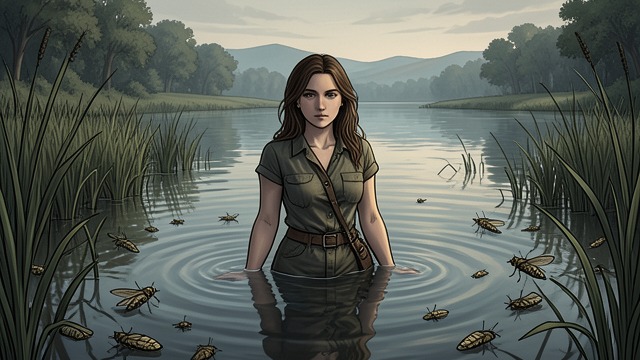
Water Remembered
The river as a sensory trigger
Cicada’s bath in the Bosque brings back memories of swimming with her Kiowa mother and companions. Water connects her present body to a lost landscape and family.
Memory exceeds explanation
Kidd cannot translate the memory into a solution. The landscape restores feeling rather than history, making grief visible in the place where it rises.
The World’s Changing Edge
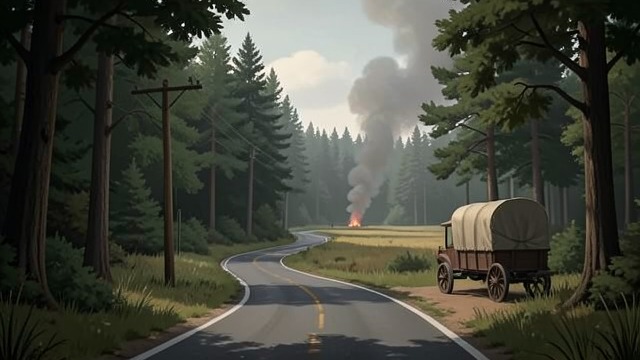
The World’s Changing Edge
Roads and modernity
Kidd reads of railways, telegraphs, and new machinery while traveling through a landscape still shaped by raids and difficult crossings. Technological change does not arrive everywhere at once.
A layered Texas
The same journey contains older routes, new political systems, and persistent frontier dangers. The land holds overlapping eras rather than moving neatly from wilderness to modernity.
Late February 1870
March 1870, at Carlyle Springs
Spring 1870, in the Texas Hill Country
March 1870, near Durand
During the later years of Kidd and Cicada’s travels
